Built your own financial model and pitch deck?
Find the weak spots before you start raising.
Raise Ready gives you a private Capital Readiness Assessment, a personalized readiness report, and a guided system to review your financial model, assumptions, use of funds, scenarios, and investor materials before serious capital conversations.
Start with the Capital Readiness Assessment
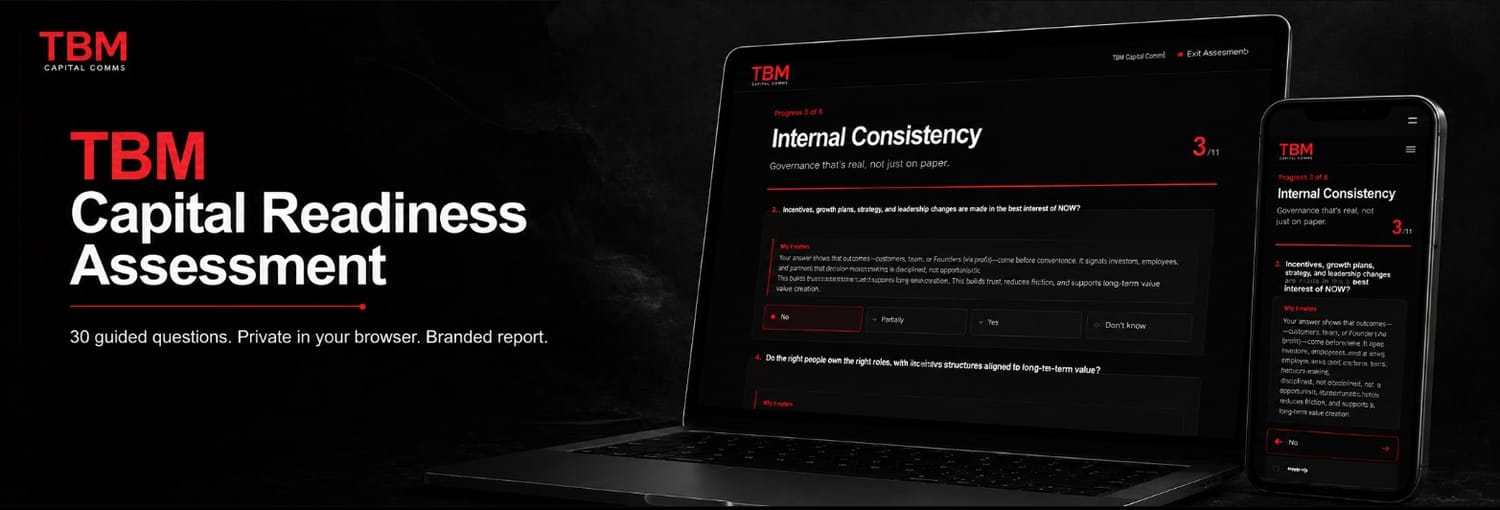
Before you work through anything, answer 30 guided questions about the structure behind your raise.
Private in your browser. No documents are uploaded and TBM does not receive your assessment answers.
You’ll receive:
A readiness score out of 100
Scores across 9 capital-readiness areas
Your strongest and weakest areas
Specific issues that need attention
A prioritized action plan
A personalized report that is also downloadable in PDF
In the first part of the system, you'll receive this assessment:
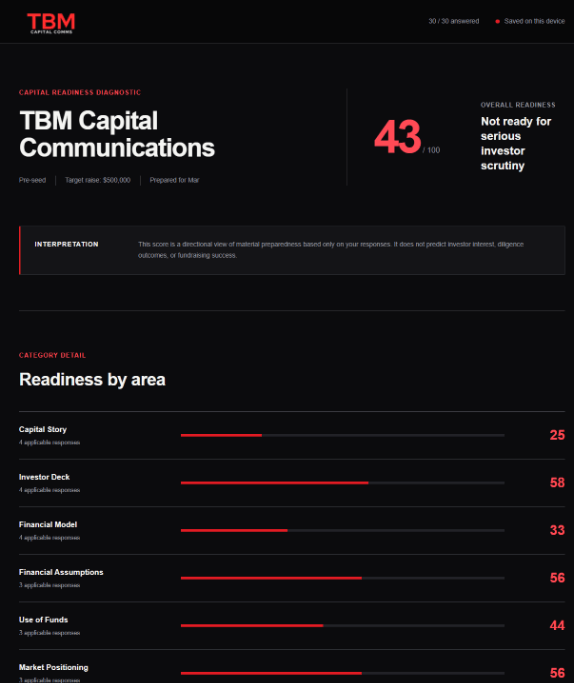
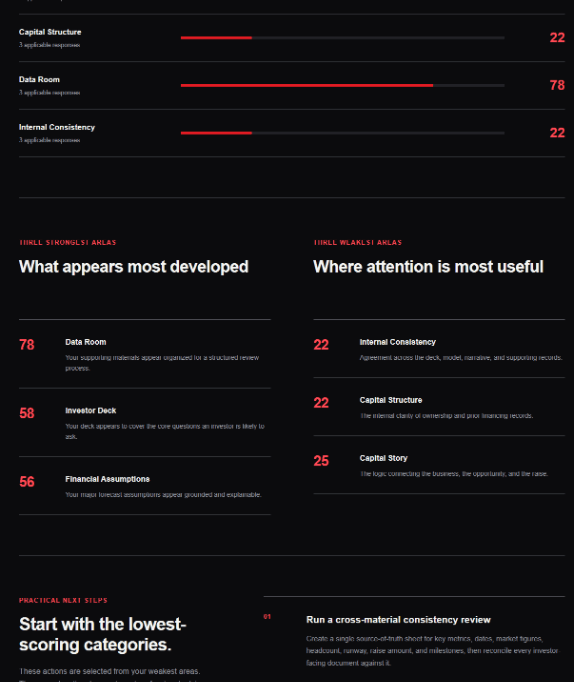
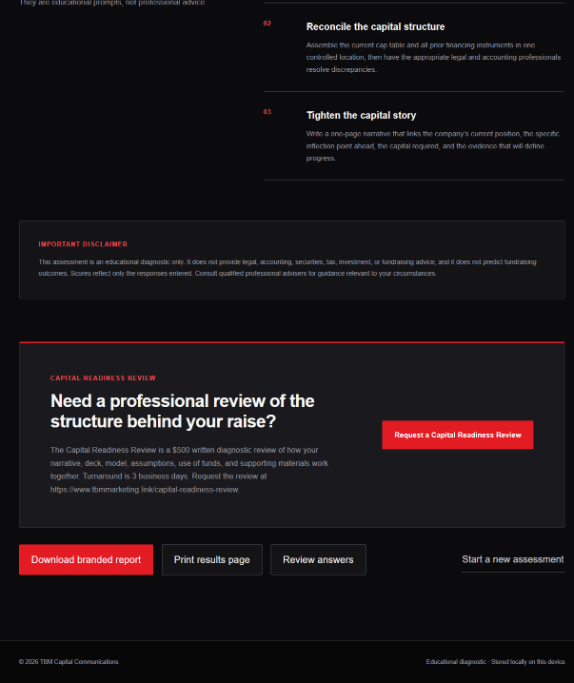
3 first pages of the report:
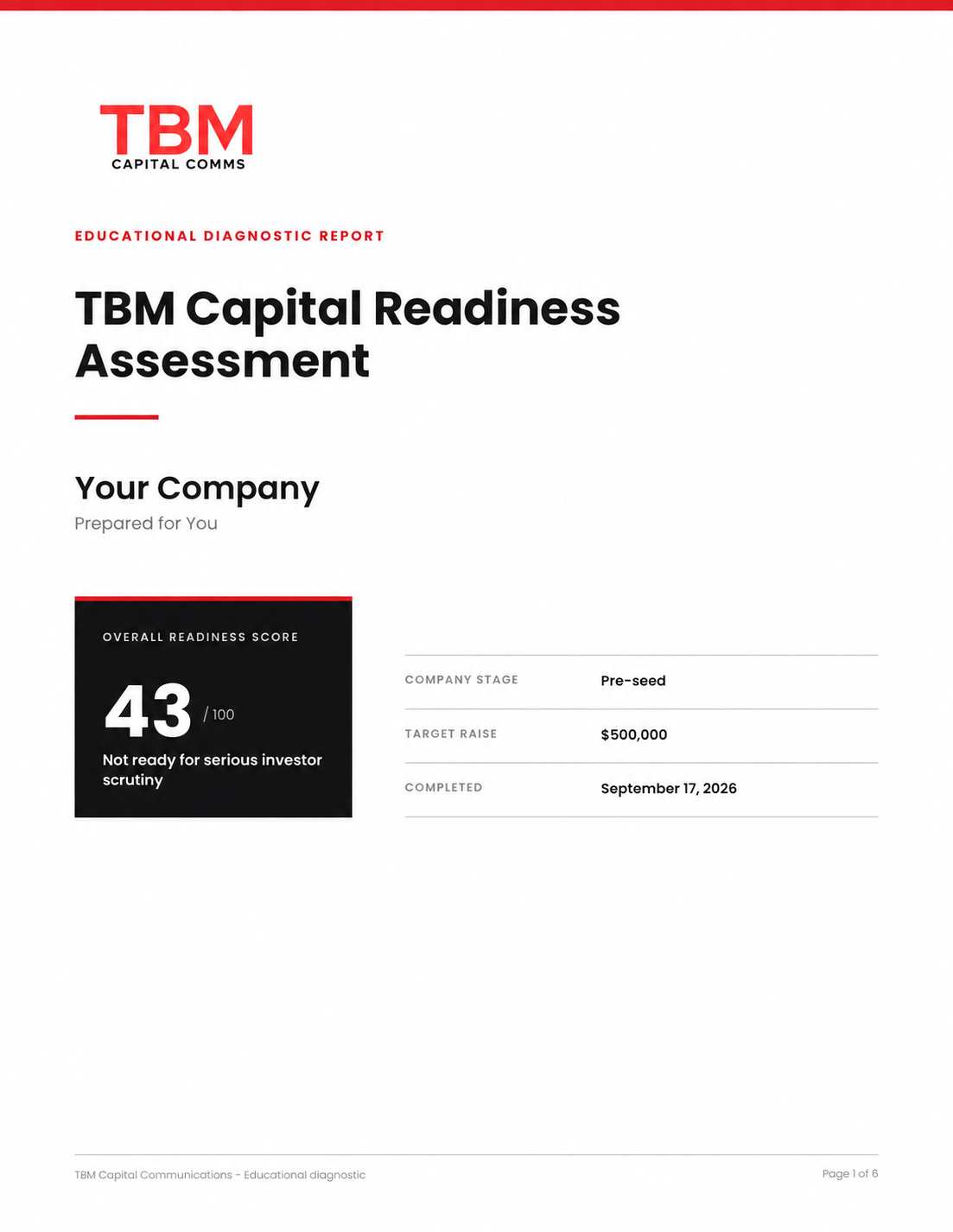
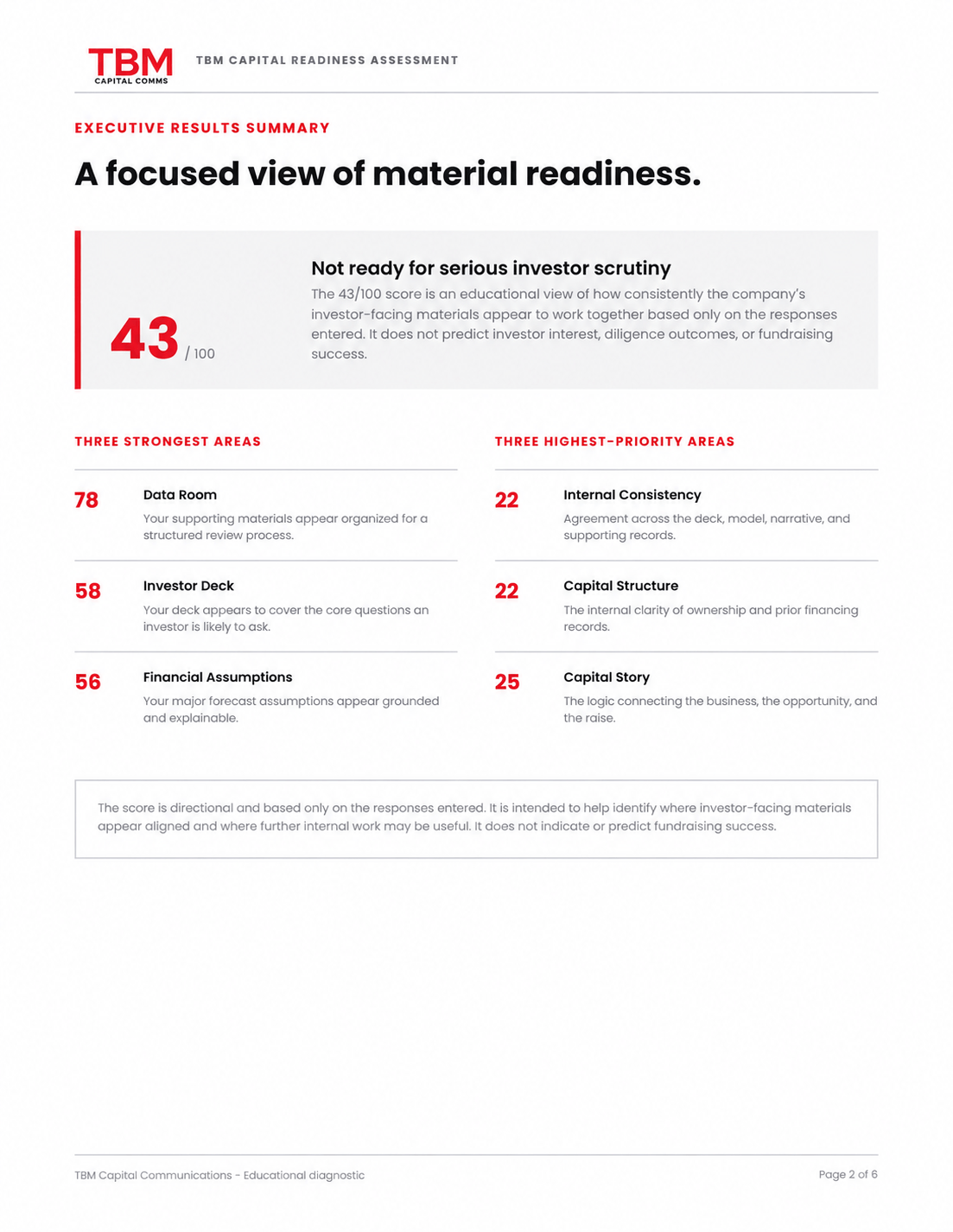
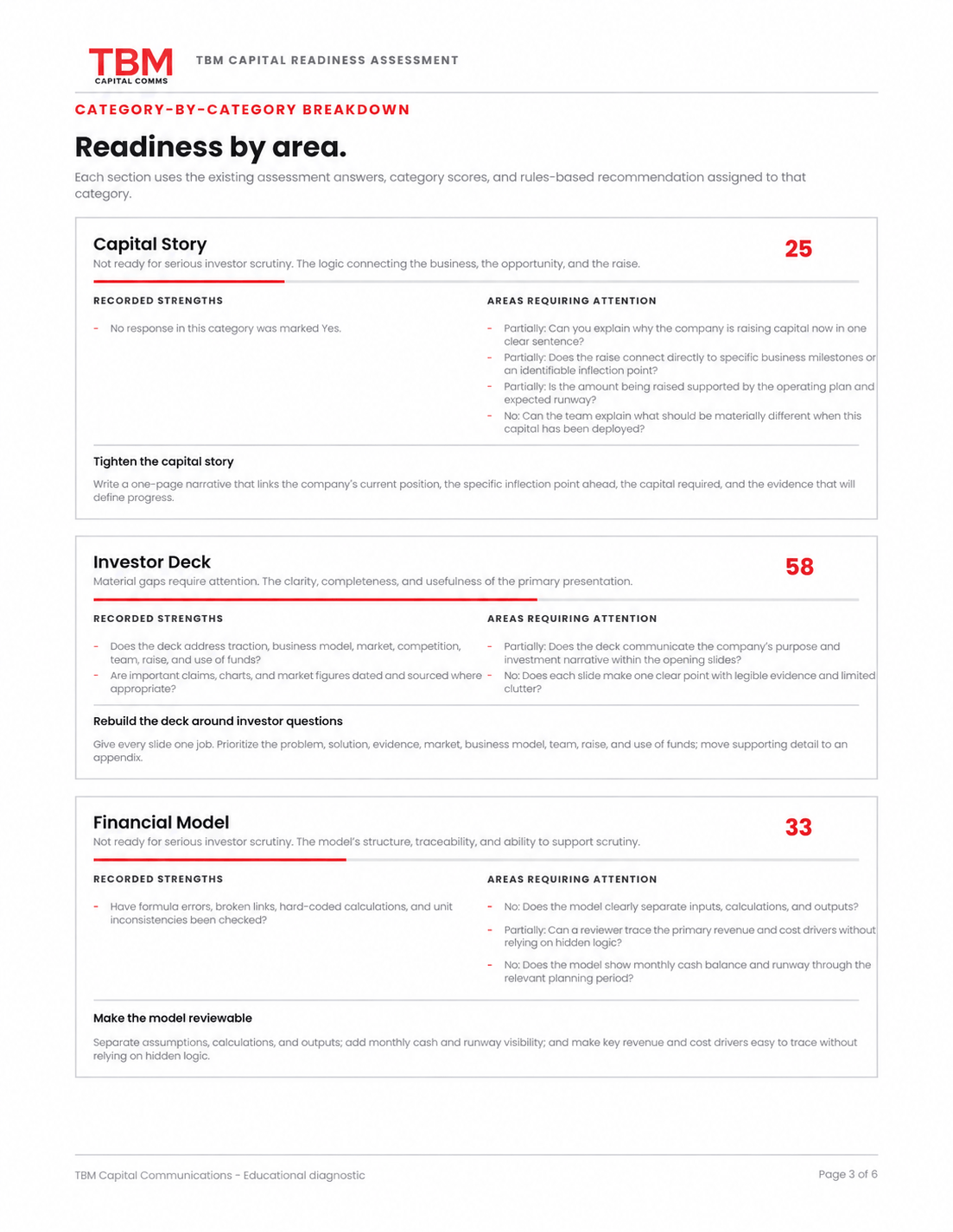
Your assessment shows you where to look. Raise Ready helps you work through it.
Your assessment shows you where to look. Raise Ready helps you work through it.
Use your results to focus on the sections that need the most work.
Inside Raise Ready, you’ll work through your financial model, assumptions, use of funds, scenarios, investor questions, and the alignment between your numbers and the story you are presenting.
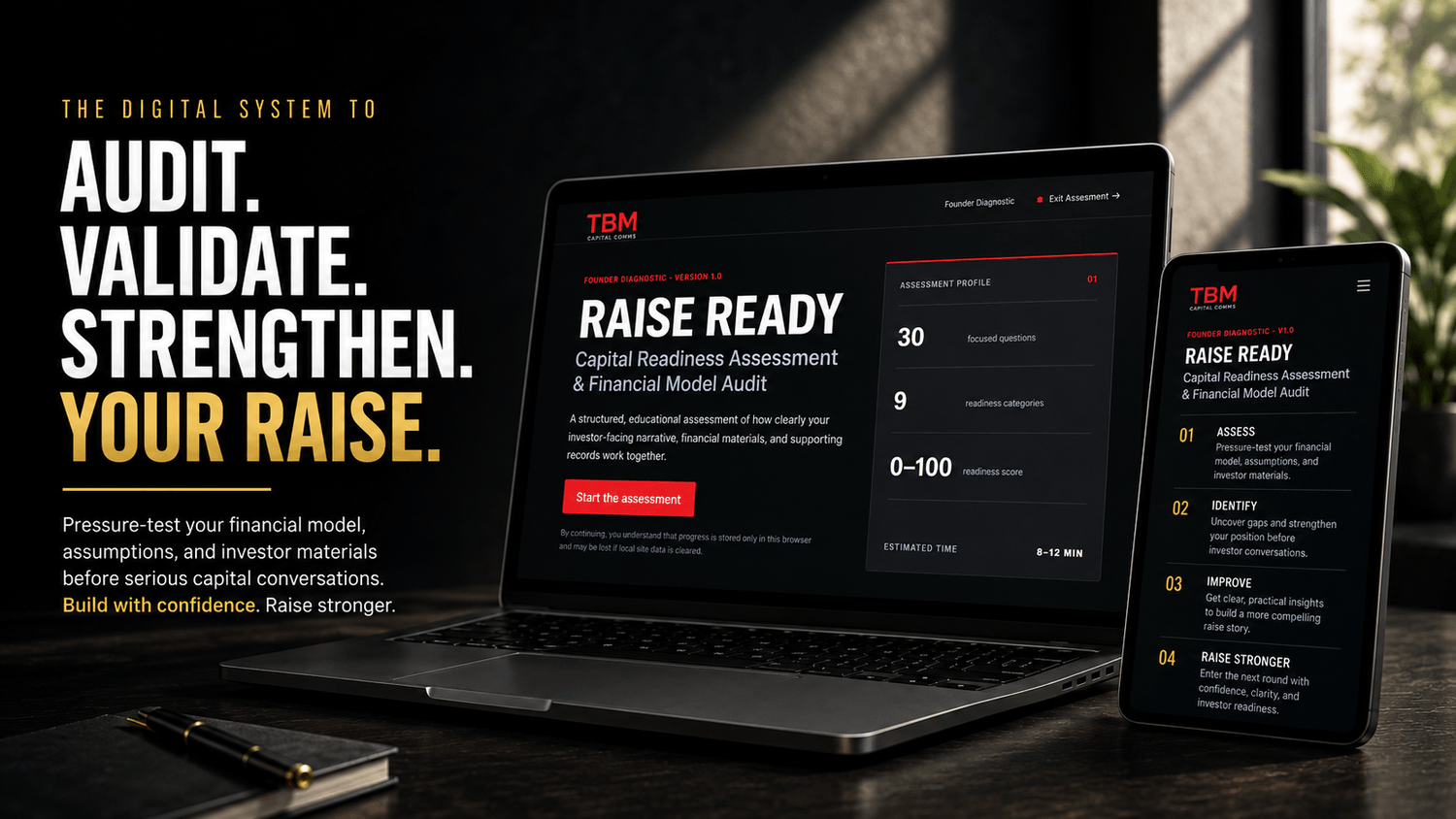
You may not need someone to build your model for you. You need to know if what you have actually holds up when someone starts questioning the numbers.
That's what this is for.
Capital Readiness Assessment Software
A 30-question diagnostic that scores your current readiness and generates a personalized report and priority action plan.
Financial Model Audit
Review the logic behind the numbers, including revenue, expenses, timing, runway, and key drivers.
Assumptions Builder
Identify the assumptions underneath your model and determine which ones are grounded, aggressive, unsupported, or unclear.
Use of Funds Builder
Work through where the raise goes, when the money is used, and whether the spending actually supports the plan.
Scenario Planning Worksheet
Review conservative, base, and upside cases so your model is not dependent on one perfect outcome.
Investor Question Bank
Prepare for the questions that expose weak logic once somebody starts looking closely.
Model-to-Deck Alignment Review
Catch contradictions between the spreadsheet, deck, capital ask, assumptions, and business story.
Final Review and Repair Plan
Identify what needs to be cleaned up before you put the materials in front of funding sources.
Get it now for only $299
Review your model, assumptions, use of funds, scenarios, and deck alignment through one structured system.
Begin with the TBM Capital Readiness Assessment Software, download your report, and use the results to guide the detailed audit inside the kit.
No. You do not submit your model, deck, or other documents to TBM as part of this product.
The Capital Readiness Assessment runs privately in your browser. Your answers, company information, scores, and report are not sent to TBM or stored in an account.
The Notion kit is also self-guided. You work through it using your own materials.
You can still use the kit.
You do not need a polished spreadsheet to begin. The process is designed to help you identify missing information, unsupported assumptions, unclear calculations, and inconsistencies while the model is still being developed.
A gap is useful information. Mark it, understand what is missing, and use the relevant section of the kit to work through it.
It is a private, browser-based diagnostic software included with the kit.
You will work through 30 guided questions across nine readiness categories. Each question includes a TBM Note explaining what to examine and what founders commonly overlook.
At the end, you receive an overall score, category breakdown, priority areas, practical next steps, and a downloadable branded report. Use that report to decide which sections of RAISE READY need your attention first.
No. RAISE READY is designed for founders, producers, project owners, and operators who are building or reviewing financial projections before presenting them to investors, lenders, partners, or other capital sources.
No. RAISE READY and the Capital Readiness Assessment are educational tools. They do not provide legal, accounting, securities, tax, investment, or fundraising advice, and they do not predict investor interest or financing outcomes.
Questions involving legal documents, tax treatment, accounting policy, securities compliance, or financing terms should be reviewed by qualified professionals.
Back to TBM Capital Communications